Halcyon Clearance
Field servicesA Newport rubbish-removal operator's booking-to-ledger pipeline: quotes from photos, on-site evidence and AI-assisted bookkeeping, built on one deterministic core ahead of opening for online booking.
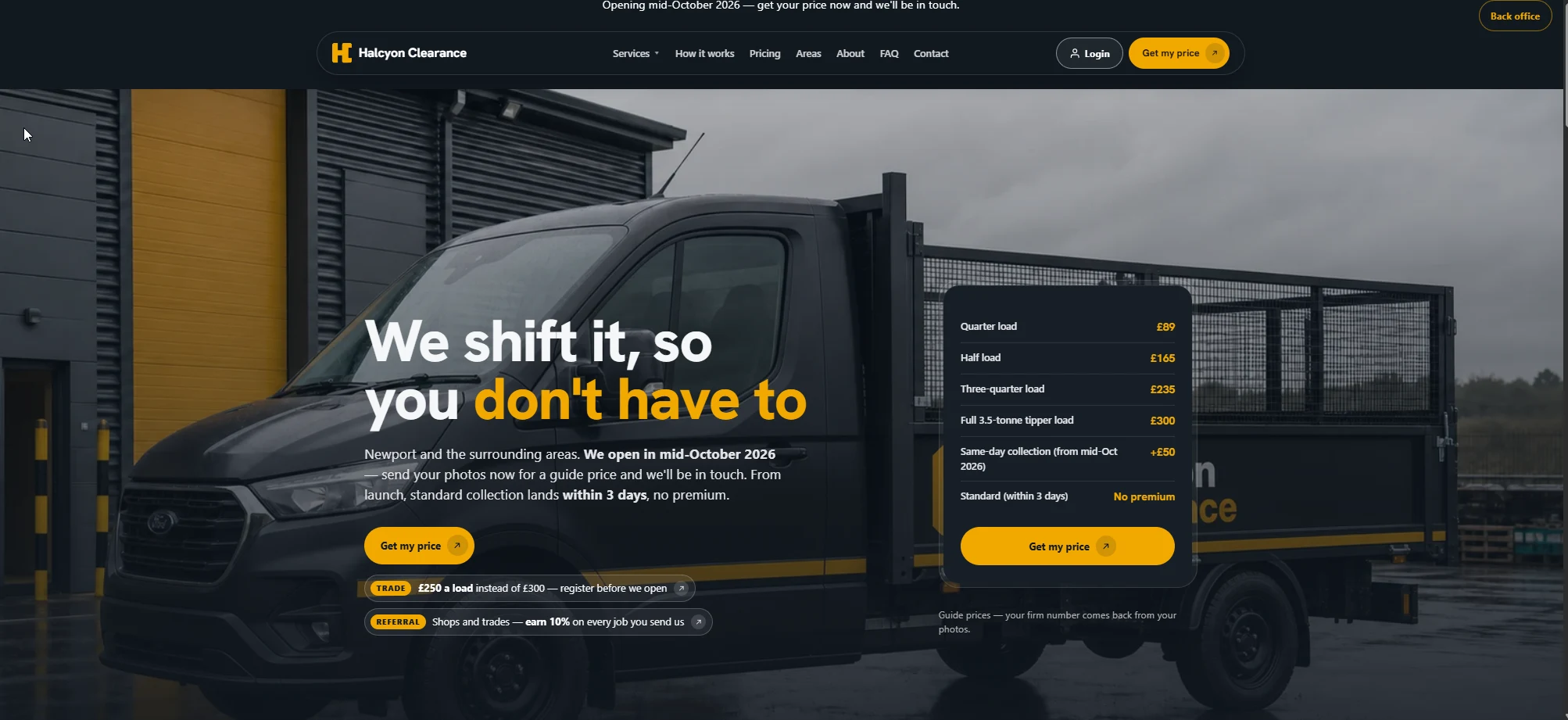
A customer picks the kind of clearance they need.
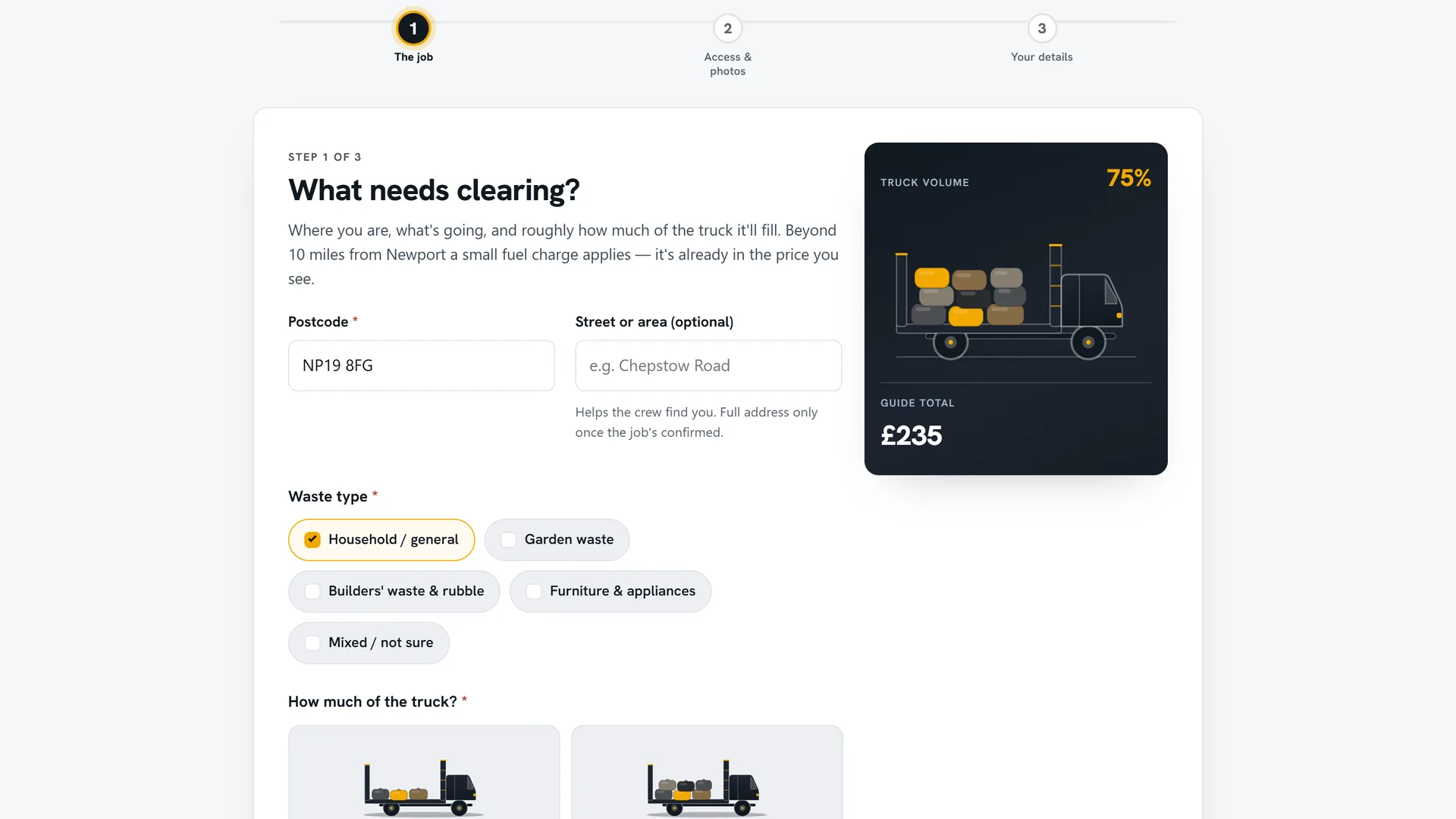
They describe the load and photograph it; the wizard shows a guide price.
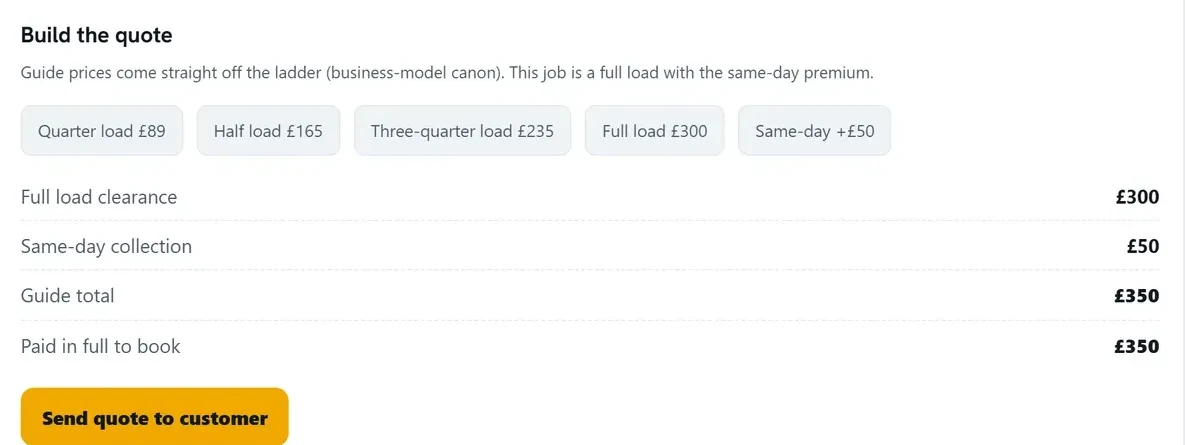
A person prices the job against one fixed ladder and sends the quote.
Rubbish removal is usually priced over the phone and re-priced on the doorstep. Travel, quoting and admin cost the same whether the truck comes home full or a quarter full, so that correction moves the whole margin.
None of six South Wales operators swept publishes a per-tonne trade figure, so pricing was built from the operator's own worked numbers.
Six calls that shaped it, and why.
The price ladder now rewards a full truck
The first ladder charged the same for each quarter of the truck, which paid the operator to make more visits.
The new ladder anchors a full load at £300 and re-prices the rungs below it, so the cost per quarter falls as the truck fills. Four quarter loads booked separately cost £356. The same rubbish in one visit costs £300.
The saving comes from spreading a fixed per-visit overhead. The tip fee isn't discounted, so the crew can explain the price on the driveway.
The gap is a fixed per-visit overhead spread across more load. It is no discount on the tip fee, which costs what it costs.
The server sets the price; the browser only shows it
The server holds the money figures. The web screens the customer and the office see are mirrors, and a test fails if a mirror drifts.
Anyone can edit a price shown in a web page, so the payable figure comes from the server's own frozen table. The browser's copy is only for display.
This came from a real miss: a collection premium offered in the wizard for weeks was never added to what anyone was charged.
The quote wizard went from six steps to three
Three steps, with every field kept.
First the job: postcode, street, what the waste is and roughly how much. Then access and photos in one pass: parking, stairs, carry distance, heavy items, date and time window. Contact details and consent come last.
Every value the six-step version collected still reaches the crew's job drawer.
Deposit removed, old deposit maths kept
Orders are paid in full when the quote is accepted. The retired deposit calculation stays in the code, wired to nothing new.
Two payment models side by side leave a small business with books it can't reconcile, so one went.
Jobs invoiced before the change still carry a deposit and a balance, and the old maths keeps that history readable.
Customer photos arrive without their location
Each photo a customer uploads is decoded, repainted and re-encoded in the browser. Only pixels come out, so the phone's location record cannot survive.
Quotes come from photos of the customer's own home, and phone photos often carry the coordinates where they were taken.
The code carries a standing instruction not to skip the round trip for already-small photos, because that shortcut would end the guarantee. A test proves it on real bytes: a photo with a genuine location record goes through, and the stored record is read back out.
One job, one reference
The reference is derived from the job's own id, so it reads the same the day the job is created or a month later.
A live walk found one job carrying three different references. A derived reference can't drift. The old stored field is still written, but the derived one is what the system trusts.
The reference follows the job from quote to books, alongside a fixed five-photo chain the crew fills on site: rubbish before, van before, rubbish after, van after, and the van at the disposal site.
Pricing, scheduling and ledger records run on rules a person can check. The AI bookkeeping tool drafts ledger entries on top, and a person confirms before anything posts.
How the result was reached.
Halcyon got a way of working that holds up on the driveway, when the customer asks why the price changed.
Where the money actually leaks, what the owner already knows, and which of their rules are real constraints. The system is designed around that.
Prices, references and records run on fixed rules a person can audit. AI sits at the edges, where being helpful matters more than being provable.
The work is carried out by AI agents under a strict operating system: plans written before code, an independent agent that checks work it did not do, and gates that refuse a claim of "done" without proof it was exercised.
MAST runs its own business on the same kind of machinery: the backlog, the documents, the reviews. Building the tools you also have to use is what surfaces the rough edges, long before a client has to find them.
Today a person reads the customer's photos. The wizard shows a guide price from the load size the customer picks, and a human sets the quote that goes back out.
Next is a quote engine that reads the photos and proposes a load size. The model would only propose a rung. The server would still set the price, a person could overrule it, and the customer would be charged the figure the server worked out.
The operator gets a price the crew can stand behind before they arrive, a record of what was collected, and a bookkeeping tool that drafts ledger entries so nobody re-types the day's takings. A person still confirms what goes on the books.
The price is agreed from the customer's photos before anyone sets off, on a ladder that rewards a full truck.
Take half an hour to find the part of your week a system like this would take off you.
No commitment and no fixed quote until it is scoped. If we go further, you own what we build.